
By: Nicole Newsom, great-granddaughter of Annie Bridges
Many of you have been following the stories from the memoirs of my great-grandmother, Annie Sutton Bridges (1896-1999). (Here’s the link to our previous newsletters if you want to catch up!) Well, this month I took a little step away from her memoirs, after discovering a story that is simply too perfect for the month of October!
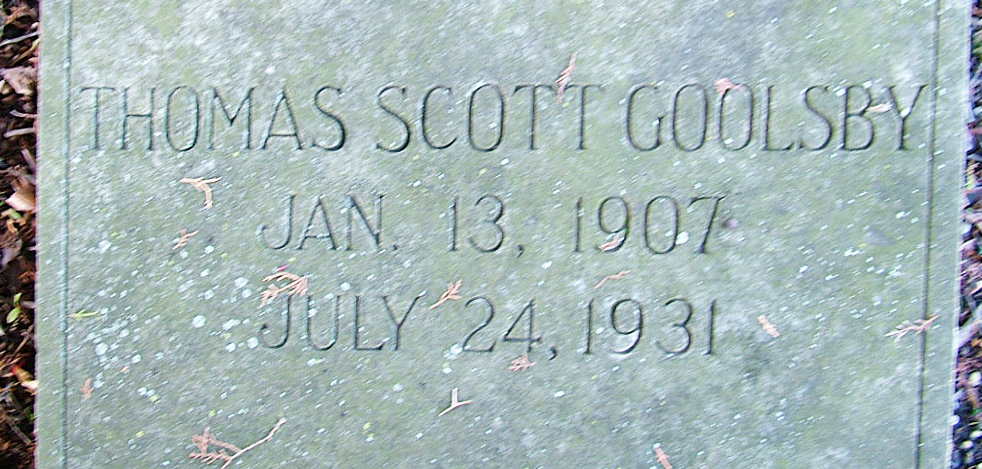
You see, I recently went on a self-guided tour of Forsyth City Cemetery. (You can pick up a copy of the guide and map at the Welcome Center or Monroe County History Museum!) Number 13 on the tour, Scott Goolsby, has a very intriguing story—a Prohibition-era tale of such mystery and suspense that you’d think you were reading an Agatha Christie novel (there’s even a psychic!). But I couldn’t escape the strange feeling of déjà vu. I had read something like this before… Sure enough, I looked back in the family scrapbook, and found a newspaper clipping of the very same story, with none other than Annie Bridges as a quoted witness!
Naturally, I connected with local historian Ralph Bass to learn more, and took a trip down the rabbit hole in the archives of Monroe County Historical Society. Sit back, and let me tell you the tale!
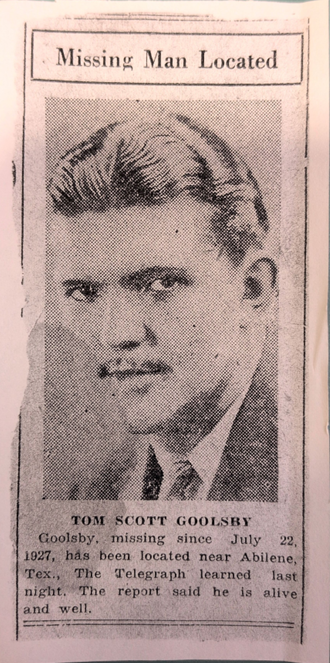
Young Scott Goolsby was a favorite of 1920s Monroe County society. Born to Dr. Robert C. Goolsby and his second wife, Mary Scott, in 1907, he was the apple of his mother’s eye, and quite the charmer. He played the role of “pig” in his grade school play “Mother Goose;” at age 13, at the Forsyth Fair he won the prize for the best three-minute speech about how to combat the boll weevil; and he was a Boy Scout, even taking on the role of Assistant Scout Master as he got older. He attended Emory Academy in Oxford, eventually becoming a “druggist” (pharmacist) at his father’s store. He loved to drive (in the days when cars were still new), and won in a race of speed against WM Tribble’s Chevrolet Touring Car in a Star Coupe.
Then on Saturday, July 23, 1927, a car belonging to 20-year-old Scott Goolsby was found abandoned on the Spring Street bridge over the Ocmulgee River, headed toward Macon:
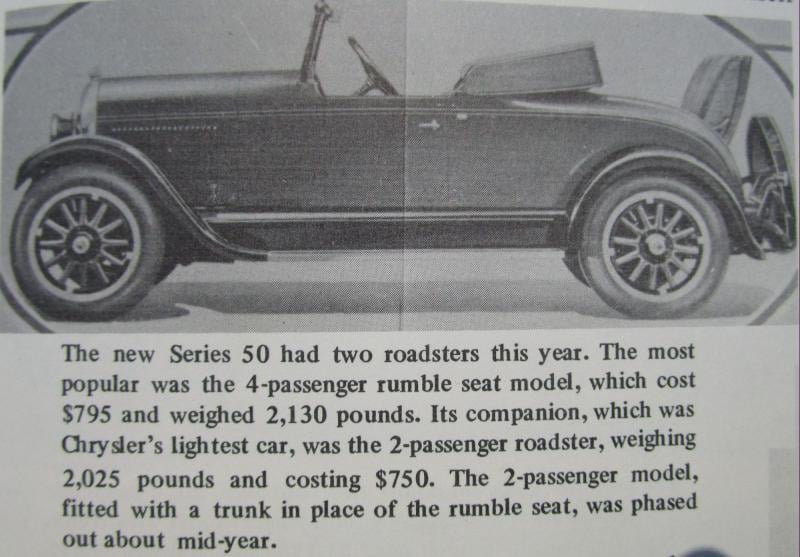
Goolsby’s car, a Chrysler “50” roadster, in which he had left Forsyth at 8 o’clock Friday night was found abandoned, parked on the left hand side of the Spring street bridge and headed toward Macon.
In it were the missing youth’s hat, with two holes completely through it where some heavy instrument had hit it, and with blood over the top and under the brim; the crank to the car, which young Goolsby is said to have always kept on the floor, several letters, which were scattered about; a pocket book which seemed unmolested; a bill fold turned wrong side out; a blue serge coat, slightly wrinkled, the property of Goolsby; the keys to the car, and a razor blade about 3/8 of an inch wide, presumably from a new type of razor, one of which Goolsby is known to have had in his pocket.
The parking lights of the car were burning. Evidences of blood were not found on some of the other articles besides the hat, which were in the car proper, nor on the floor of the bridge, the sidewalk adjoining or the balustrade that reaches up some four feet along the sidewalk.
—The Macon Telegraph July 24, 1927 / reprinted in The Monroe Advertiser July 28, 1927
Goolsby’s disappearance led to a 14-month, nation-wide search. Updates on the case were printed in newspapers not only across the state, but in others as well, even making it into The New York Times. Just when the trail would go cold, a new witness would come in, leading the investigators to Florida, Alabama, Tennessee, Louisiana, and beyond!
One such witness was that of 31-year-old Annie Bridges, as she was about to board a train to Macon in Jacksonville, FL with her husband Morgan:
Mrs. Morgan Bridges, wife of a Southern railway operator at Berner, said that she saw young Goolsby in the Jacksonville terminal at eight o’clock Sunday morning.
“I know positively that it was Tom Scott Goolsby, because I have been knowing him for some time. I passed within an arm’s reach of him and called the attention of my husband to the fact that I had seen him,” Mrs. Bridges is quoted as saying.
Mr. and Mrs. Bridges arrived home early Monday morning, and soon after their arrival Mrs. Bridges called authorities and told of seeing the young druggist.
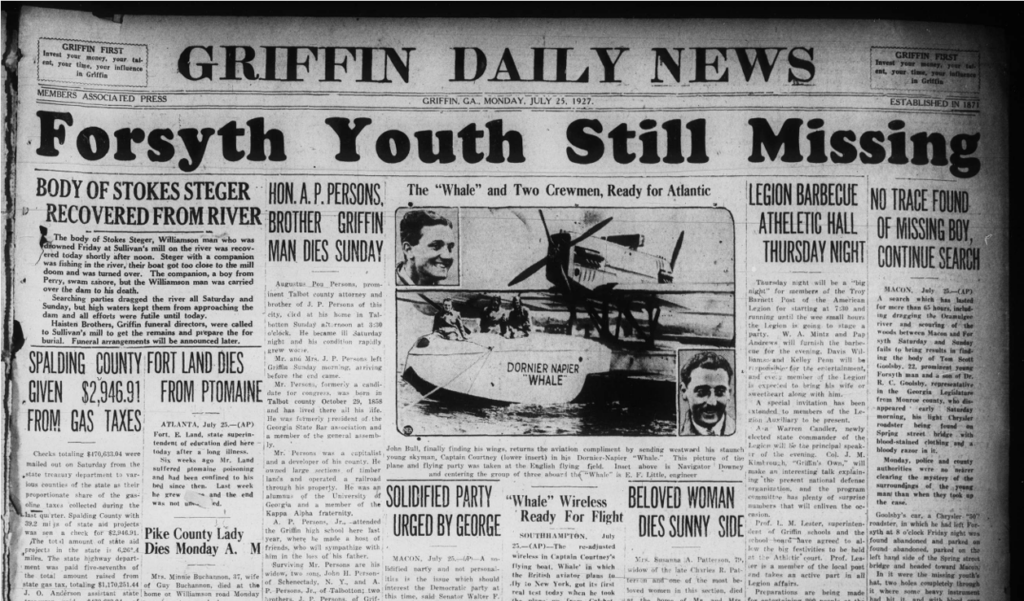
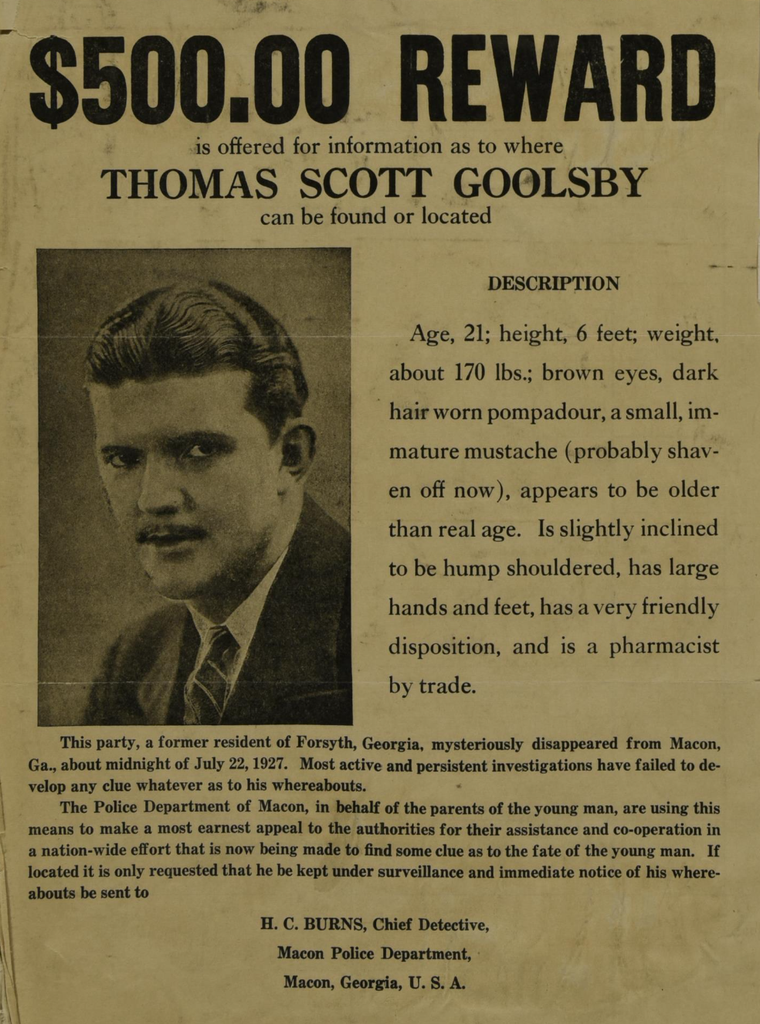
Theories as to the mystery of Scott Goolsby abounded! Was he murdered? Kidnapped? Did he plan it all, and run away to Cuba? Or South America?! Dragging the Ocmulgee River failed to reveal a trace of him, and as of April 1928, “he has not been heard from, except for a report that he was seen several months later in Birmingham, Alabama.” (The Monroe Advertiser, April 5, 1928)
In August 1927, Goolsby’s Pharmacy placed an ad in The Monroe Advertiser calling in accounts, and the family began offering large rewards for information — $500 for his body, dead or alive, and a reward of $1000 for the murderer in the event he had been killed. The Macon Telegraph added its own $250 to this in December 1927 for information.
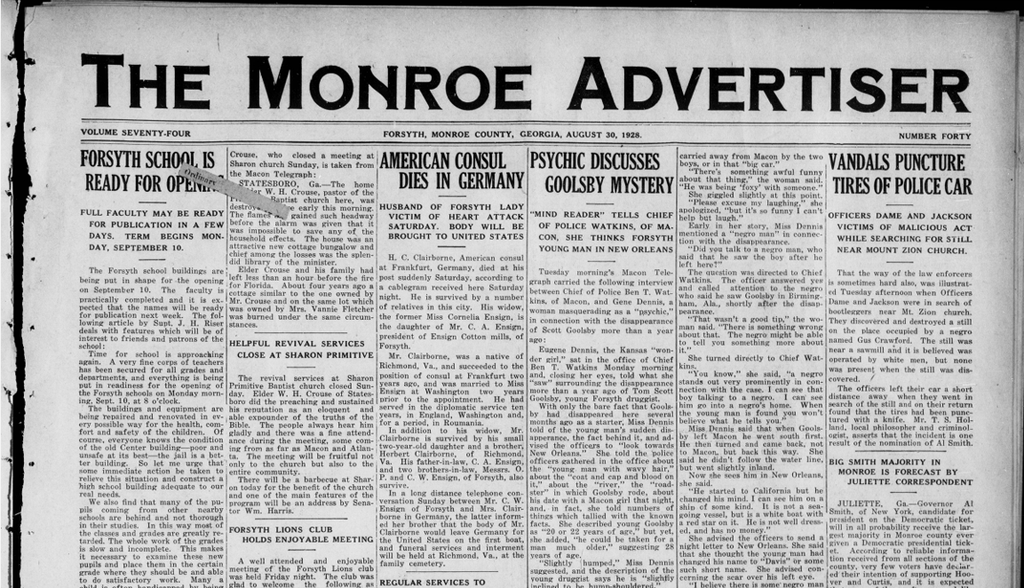
Then, more than a year after Goolsby’s disappearance, Kansas psychic Eugene Dennis was brought in for an interview with Macon Police Chief Ben Watkins, witnessed and reported in The Macon Telegraph (and then in The Monroe Advertiser, August 30, 1928).
Eugene Dennis, the Kansas “wonder girl,” sat in the office of Chief Ben T. Watkins Monday morning and, closing her eyes, told what she “saw” surrounding the disappearance more than a year ago of Tom Scott Goolsby, young Forsyth druggist.
With only the bare fact that Goolsby had disappeared here several months ago as a starter, Miss Dennis told of the young man’s sudden disappearance, the fact behind it, and advised the officers to “look towards New Orleans.” […]
“This young man is not a criminal. He is mentally wrong. He does things which take him in an older environment.”
[…] Then the “wonder girl” told where it all happened.
“I see a fight which took place near a large school,” she said. “I can see three boys. One is the boy which disappeared; the other is a tall blonde.” She could only describe the third young man as “helping the blonde.”
“The young man who disappeared was riding by himself in a roadster, I can see. The other two young men were riding in a larger automobile, possibly a five or seven passenger, and the two cars met near the school building.”
The officers thought of the North Highlands school building, Alexander III.
“This was the beginning of the trouble,” she said. “Those two boys surely did beat the other boy (Goolsby). I can see his eye and his nose bleeding, and when he is found he will have a scar over his left eye.”
“The two boys who jumped him did not have a murderous intent, but merely wanted to beat him up. Only fists were used in the fight. But he (Goolsby) was knocked unconscious.” […]
Miss Dennis said that Goolsby did not leave on his own accord, but was carried away from Macon by the two boys, or in that “big car.”
[…] Miss Dennis said that when Goolsby left Macon he went south first. He then turned and came back, not to Macon, but back this way. She said he didn’t follow the water line, but went slightly inland. Now she sees him in New Orleans, she said.
“He started to California but he changed his mind. I can see him on a ship of some kind. It is not a seagoing vessel, but is a white boat with a red star on it. He is not well dressed, and has no money.”
She advised the officers to send a night letter to New Orleans. She said that she thought the young man had changed his name to “Davis” or some such short name. She advised concerning the scar over his left eye. […]
It is uncanny how much the psychic got right when Goolsby was found just a couple of weeks later! According to accounts, some former Monroe County residents, friends of the Goolsbys, had moved to Abilene, Texas where they saw Scott Goolsby on Labor Day, 1928. Dr. and Mrs. Goolsby quickly made the trip upon receiving their friends’ letter describing the event. There they found their now 22-year-old son living with amnesia under the assumed name J.R. Morrison. The story of their two-week visit (of which they returned without their son in tow) was reported on the front page of the September 20, 1928 Monroe Advertiser:
SCOTT GOOLSBY IS FOUND IN TEXAS
PAST LIFE IS A BLANK
Believed To Be Suffering Loss of Memory Due to Blows on Head, Scars of Which Are Visible. Labored Under Impression Parents Were Dead and Was Using Name of J. R. Morrison.
Goolsby could not recall anything before July 28, 1927—the moment he found himself along the water front in New Orleans. Six days after his initial disappearance from Macon. He had a bad scar across the back of his head, another on the temple, and others on his side. It was assumed the injury to his head caused the amnesia.
“He did recall meeting a stranger in New Orleans when he came to his senses, and that man took an interest in him and gave him a dollar with which to obtain some food. He was penniless, hungry, weak. He told me that when he ‘woke up’ blood gushed from his nose and ears, which I believe was due to the blow he received on his head.
“He told me that he asked this stranger where he was, who he was and how he happened to be there, but the stranger could not answer any more than he. He recalled the fact that the stranger remarked, ‘You’ve been in a fight.’ He said that after the man gave him the dollar and left he never saw him again.”
—Quote from Dr. Goolsby in The Monroe Advertiser, September 20, 1928
Anyone else picking up on things the psychic noted? Scar on the temple, “mentally wrong,” New Orleans? Not well dressed, has no money…
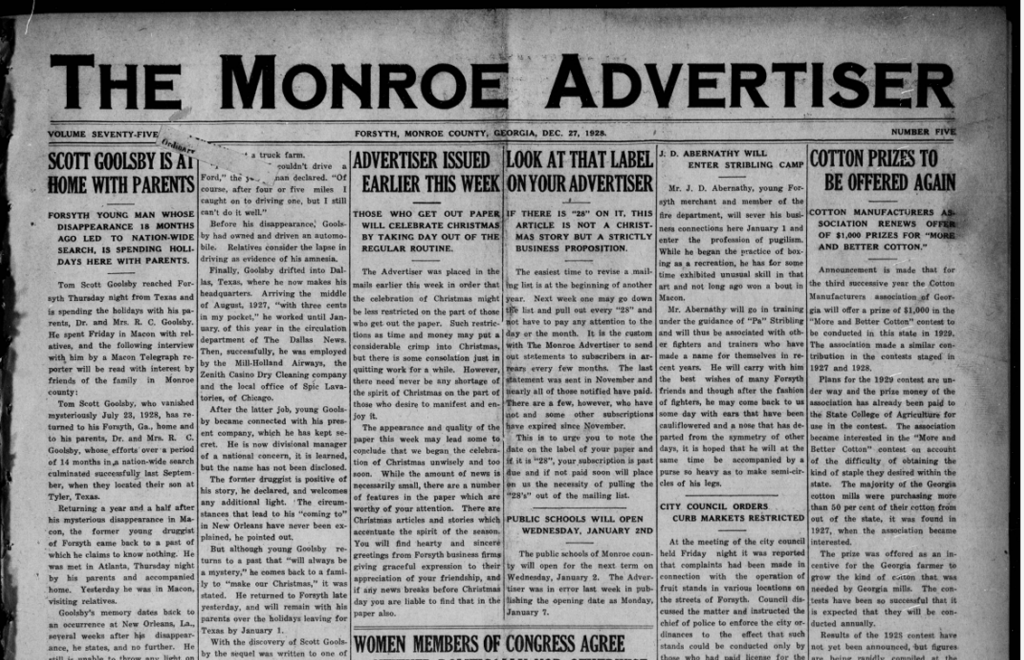
In New Orleans, Goolsby got a job in a restaurant on the waterfront, followed by a series of other jobs which brought him to Abilene, Texas. To the moment where he answered a knock on the door, only for a strange woman (his mother) to throw her arms around his neck! It took a month for him to believe that he was indeed Thomas Scott Goolsby, and he didn’t return home to Forsyth until December—a holiday trip to spend Christmas with his family. There he was surrounded by family and friends, familiar places and people that all hoped would spark the return of his memory. Alas, Goolsby’s memory never did come back, and he made his home in Texas, starting a family, learning how to drive (remember how he once won a race?!), and making a new career as a chewing gum salesman. That is until…
July 1931—four years nearly to the day of his original disappearance, Scott Goolsby found himself in an automobile crash, taking another blow to the head which miraculously restored his memory! He was able to reunite and reminisce with his family for about a week before complications from injuries sustained in the crash took a turn for the worse. He died of pneumonia—I’d like to think in his mother’s arms—on July 24, 1931, and his body was returned to his boyhood home, where he now lays buried in Forsyth City Cemetery.